Fitting culture to strategy: the competing values framework as a lens to visualise change
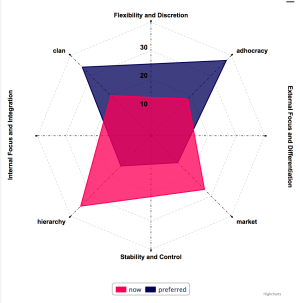
A few weeks ago, I published an article on LinkedIn partly in partial fulfillment of the requirements for the completion of the Henley Business School’s Managing People Module and partly out of interest (the interest part deals with the choice of the subject I wrote about). I am reproducing the article below – for those of you that follow this blog but may not be connected with me on LinkedIn. All organisations have a ‘way they do things’. These ways are collectively called culture or organisational culture (or similar monikers). Organisational culture, stem from a number of sources – including the founders philosophy (think Google, where in the early days engineers were given more priority over product directions than was allowed the project manager types – http://www.howgoogleworks.net/), deliberately (when consultants are brought in to help devise one) and by evolution (when things just happen in response to external and sometimes internal stimuli) – and gradually changes organically over the years as the organisation grows or diminishes or as its internal and external context changes. The Competing Values Framework (CPF), introduced by Quinn, R.E. & Rohrbaugh, J, in their work titled: A Spatial Model of Effectiveness Criteria: Towards a Competing Values Approach to Organisational Analysis, published in 1983, provides a lens through which to view the organisation and its culture (current culture and the desired culture). The authors argue that organisations have 4 possible dominant cultures. These cultures are clan, adhocracy, hierarchical and market. Each prioritises people (employees), customers, the way work